 Aave
Aave borrowing, repayment and withdrawals change different parts of your position
last updated
Aave lets you borrow against collateral, repay an existing obligation or withdraw supplied assets when the position and market permit. Borrowing provides tokens while adding debt; withdrawing returns supplied tokens without reducing what you owe. Repayment reduces that obligation and can release collateral, although available liquidity still limits withdrawals. The choice starts with the balance you want to change: spendable tokens, outstanding debt or assets remaining in the protocol. Before committing, consider the resulting health factor and the cost of keeping any debt open. A completed transaction should leave a matching account balance, not just a signed wallet request.
A withdrawal now or repayment first
Consider an account with supplied collateral and outstanding debt whose owner wants to retrieve part of the supplied asset. The intended withdrawal must fit available liquidity and leave enough collateral backing the remaining loan. If the preview satisfies those conditions and leaves an acceptable margin for price changes, withdrawal can proceed without repayment. Completion means the recipient receives the tokens and the supplied balance falls by the corresponding amount.
If the withdrawal would remove too much backing, the owner can reduce the requested amount or repay debt first. Repayment from wallet funds requires the borrowed asset or its native equivalent through a supported gateway, any necessary transfer authorization and sufficient funds for network fees. Its cost depends on accrued interest and transaction conditions. After repayment, the owner must reassess the withdrawal using the updated position.
- Keep the requested withdrawal within the asset's available liquidity.
- Check the remaining collateral against all outstanding debt.
- For repayment first, have the required repayment tokens and network fee balance available.
- Accept the transaction cost before authorizing the chosen action.
- Confirm receipt of the withdrawn tokens and the corresponding supply reduction.
If liquidity remains insufficient after repayment, stop the withdrawal attempt. Lower debt doesn't create liquidity in a different supplied asset.
Account details before authorization
The selected account, network and market must match the position that the transaction will change. A wallet balance alone doesn't identify the loan or supply position. Compare the requested asset and amount with the position details, then review the recipient and any contract spending permission. Where the interface provides a preview, inspect the expected debt, collateral and health factor before signing. A preview describes a proposed operation under the state it reads. Prices, interest and liquidity can change before execution, so an earlier preview isn't proof that the transaction will succeed.
Should I borrow more or withdraw my supplied assets?
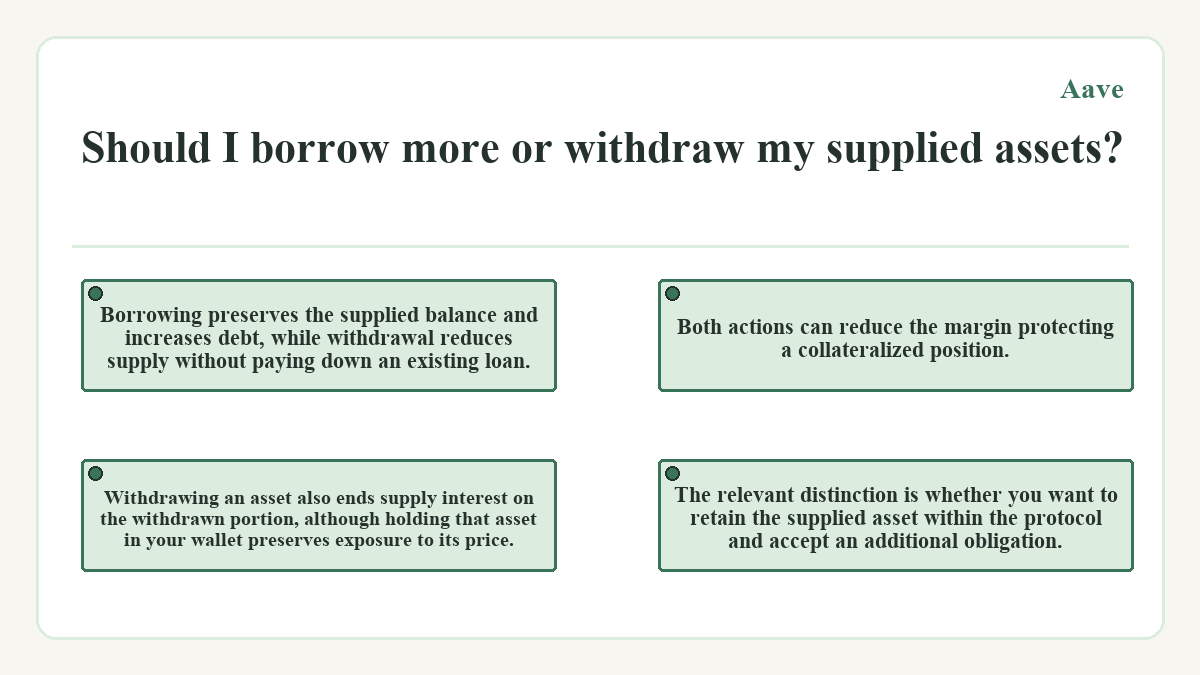
Borrowing preserves the supplied balance and increases debt, while withdrawal reduces supply without paying down an existing loan. Both actions can reduce the margin protecting a collateralized position. The relevant distinction is whether you want to retain the supplied asset within the protocol and accept an additional obligation. Withdrawing an asset also ends supply interest on the withdrawn portion, although holding that asset in your wallet preserves exposure to its price.
Available borrowing capacity is a protocol limit, not a spending target. It depends on eligible collateral, market settings and liquidity for the requested asset. The liquidation threshold serves a separate purpose: it determines when collateral no longer adequately supports debt. A health factor below 1 makes a position eligible for liquidation. Even a transaction that passes the protocol's checks may leave little room for interest growth or adverse price movement.
Partial repayment and a complete exit
Partial repayment reduces the obligation without requiring the entire loan to close. It can suit a position that needs less debt while retaining some borrowing. Repayment with tokens from the wallet leaves the supplied collateral in place, so its effect differs from a repayment method that consumes supplied assets. The amount available for later withdrawal still depends on the resulting position.
Interest continues to accrue on debt that remains after a partial repayment. Paying back the amount originally borrowed may therefore leave an outstanding balance. A full repayment must cover the debt recognized when the transaction executes, including accrued interest. Any full-repayment option also needs enough repayment tokens to complete its request.
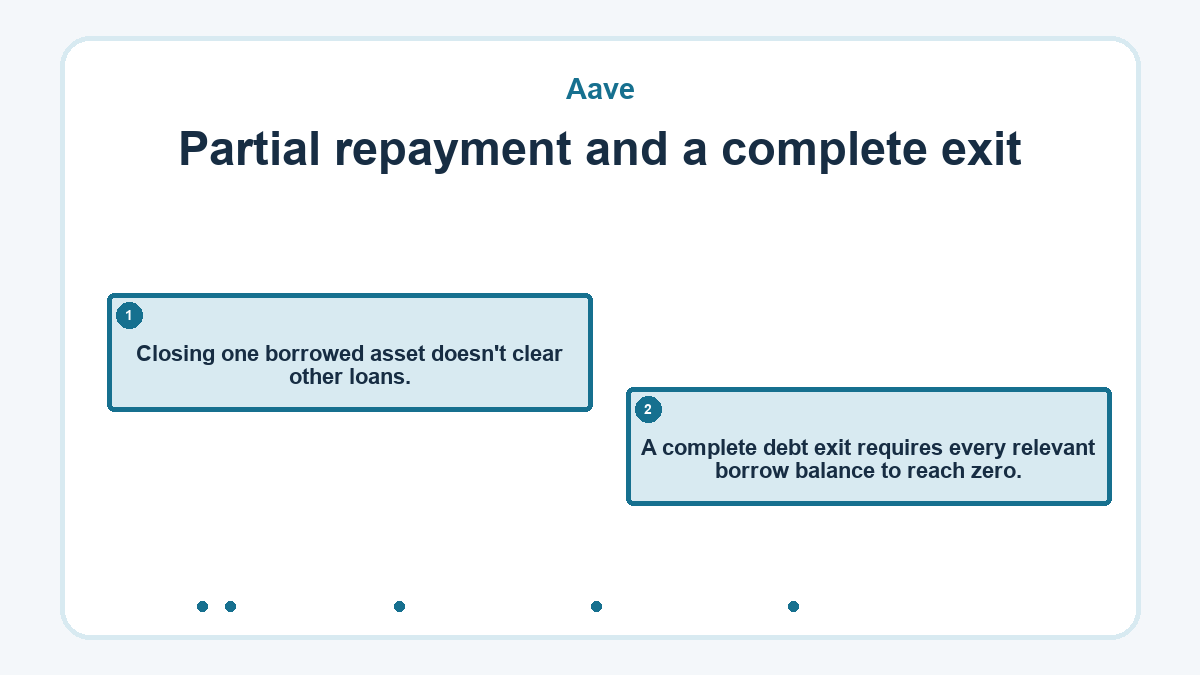
Closing one borrowed asset doesn't clear other loans. A complete debt exit requires every relevant borrow balance to reach zero.
Why can a withdrawal remain unavailable after repayment?
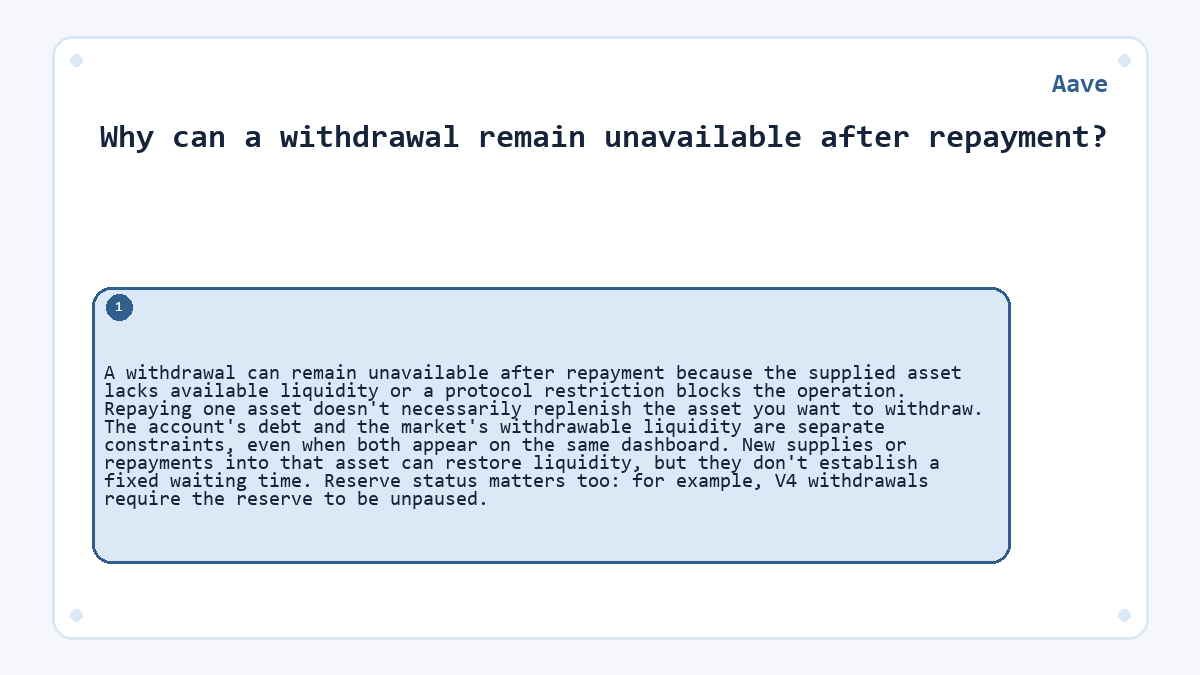
A withdrawal can remain unavailable after repayment because the supplied asset lacks available liquidity or a protocol restriction blocks the operation. Repaying one asset doesn't necessarily replenish the asset you want to withdraw. The account's debt and the market's withdrawable liquidity are separate constraints, even when both appear on the same dashboard. New supplies or repayments into that asset can restore liquidity, but they don't establish a fixed waiting time. Reserve status matters too: for example, V4 withdrawals require the reserve to be unpaused.
Borrowing costs and the timing of repayment
The amount owed depends on the borrowed balance, elapsed time and the interest rates that apply while debt remains open. A displayed annual rate describes borrowing conditions at that point; it doesn't lock the final cost. In V3, the reserve's interest rate strategy responds to utilization under configured curve parameters. Other versions can add different inputs. In V4, collateral-related risk premiums can affect borrowing costs, so changing collateral can alter more than the health factor.
Repayment reduces future interest by reducing the balance on which it accrues. Network fees add a separate cost to each executed transaction, including a separate approval transaction when required. Repaying through an exchange of collateral introduces execution terms for that exchange as well. Supply income and borrowing charges apply to their respective balances; comparing their displayed percentages alone doesn't establish whether holding the position costs money overall.
Confirmed changes and the remaining record
A confirmed borrow can't be undone by closing the interface or disconnecting the wallet. Repayment is a subsequent transaction, with its own cost and account change. Likewise, withdrawing and later supplying again creates separate operations rather than erasing the withdrawal. The transaction record identifies what occurred, while the account state shows what remains. Activity details can include the transaction identifier, network, asset and amount. An approval record alone doesn't prove that repayment occurred. For a complete debt exit, the decisive balance is the remaining debt across the position: 0.
Your questions, answered
Can I repay a loan with a different token from the one I borrowed?
Direct repayment uses the borrowed asset. For wrapped-native debt, a supported gateway also accepts the chain's native token and wraps it for repayment. A supported repay-with-collateral feature can convert supplied assets to fund repayment, but its availability and exchange conditions depend on the market and interface. The conversion must provide the asset needed to settle the debt.
Is there a scheduled repayment deadline for an ordinary borrow position?
An ordinary overcollateralized borrow position has no fixed repayment term, provided it remains adequately collateralized. Interest keeps accumulating while debt remains open. Price changes and that growing obligation can make repayment necessary to prevent liquidation before any date you had planned.
Does rejecting a repayment request cancel an earlier token approval?
Rejecting the repayment request doesn't revoke a token approval that already succeeded. That approval is a separate permission recorded by the token contract. An unused allowance can remain available to the approved spender until you change it or subsequent transfers consume it.
Must I disable collateral before withdrawing it?
You generally don't need to disable an asset's collateral status before withdrawing an otherwise permitted amount. The withdrawal must still satisfy the account's collateral requirements. Disabling collateral has its own checks and doesn't provide a way around restrictions protecting an outstanding loan.
Which supplied tokens can directly repay a V3 debt without a swap?
V3 supports repayment with aTokens belonging to the same reserve as the borrowed asset. This operation reduces the matching supplied balance and debt without exchanging one underlying asset for another. Availability through a particular interface can differ from the underlying contract capability.
Will borrowing again after repayment restore my previous loan terms?
A new borrow uses the conditions that apply when it executes. Repayment doesn't reserve the previous borrowing capacity, liquidity or rate. Changes to collateral value, market parameters and available funds can make the new amount or borrowing cost different from the earlier position.
How does repayment affect interest on collateral that I leave supplied?
Repayment from wallet funds doesn't itself withdraw your supplied assets, so those assets can continue accruing supply interest under the market's conditions. Repayment that uses supplied assets reduces that supply balance instead. Neither method fixes the future supply rate.