 Aave
Aave collateral eligibility for a new loan
last updated
Aave collateral can fail to support a new loan when the supplied asset isn't enabled, its effective loan-to-value limit is zero or existing debt consumes the available capacity. Borrowing also depends on the selected market's liquidity and restrictions. A visible supply balance therefore doesn't establish that the account can borrow the requested asset or amount.
The useful distinction is between a missing collateral contribution and a separate restriction on borrowing. In V3, the account's selected mode and deployed contract version also affect eligibility, so identical token balances can produce different borrowing limits.
Key takeaway: A supplied balance supports new borrowing only when its collateral settings, effective LTV and the selected market permit the loan.
Disabled collateral and balances in the wrong market
A disabled collateral setting excludes that supplied asset from the backing available to the account's borrowing position. Tokens held in the wallet haven't necessarily entered the lending pool. Likewise, a supply position in another market doesn't automatically support the account in the market currently selected. The relevant records are the account address, market, supplied balance and collateral status.
A successful supply and an enabled collateral setting establish different facts. The supply records assets held in the pool for the beneficiary; the collateral setting determines their participation in borrowing calculations. A pending transaction or a stale dashboard can obscure that distinction. Reading the confirmed account state resolves whether the missing contribution reflects an incomplete action or an actual eligibility restriction.
Why can a healthy account have no borrowing power?
A healthy account can have no borrowing power because loan-to-value limits and liquidation thresholds govern different boundaries.
Loan-to-value, or LTV, limits the debt that collateral can support when opening or increasing a loan. The liquidation threshold determines how much collateral value counts toward the position's health factor. That factor compares the threshold-adjusted collateral value with outstanding debt. A V3 position with a health factor below 1 meets the health-factor condition for liquidation. Other execution conditions can still affect whether liquidation proceeds.
Remaining borrowing capacity broadly equals the sum of enabled collateral values multiplied by their effective LTVs, less existing debt. All values must use the same valuation currency. A positive health factor margin doesn't establish positive borrowing capacity, and positive capacity doesn't establish available liquidity. An asset with zero effective LTV contributes no new borrowing power even when its positive liquidation threshold still supports account health.
Collateral eligibility inside eMode
Efficiency Mode, or eMode, applies category-specific collateral and borrowing rules that can differ from the market's default settings. The effective LTV is the value that applies to this asset in the account's selected mode. A percentage displayed for another category doesn't describe the account's usable limit.
V3.6 supports collateral eligibility exclusively within particular eMode categories, together with category-specific zero-LTV restrictions. Consequently, a default-market restriction doesn't necessarily describe eligibility inside a qualifying category. Borrowable assets also have their own category rules. Selecting a mode requires compatibility with the existing position, rather than simply choosing the largest displayed percentage.
V3.7 adds an isolated eMode setting. Where that setting applies, supplied assets outside the category's collateral set contribute zero LTV. Entry also rejects incompatible enabled collateral. If governance activates isolation for an existing category, affected collateral can lose borrowing power without losing its liquidation-threshold contribution. That change alone doesn't imply immediate liquidation.
Valuation changes and restrictions on the borrowed asset
Oracle valuations and accrued debt can reduce borrowing capacity even when the supplied token quantity appears unchanged. An oracle provides the asset prices that the protocol uses in its account calculations. A wallet's displayed valuation can use a different price feed. Falling collateral value or rising debt value changes the borrowing calculation; borrowing interest also increases the obligation over time.
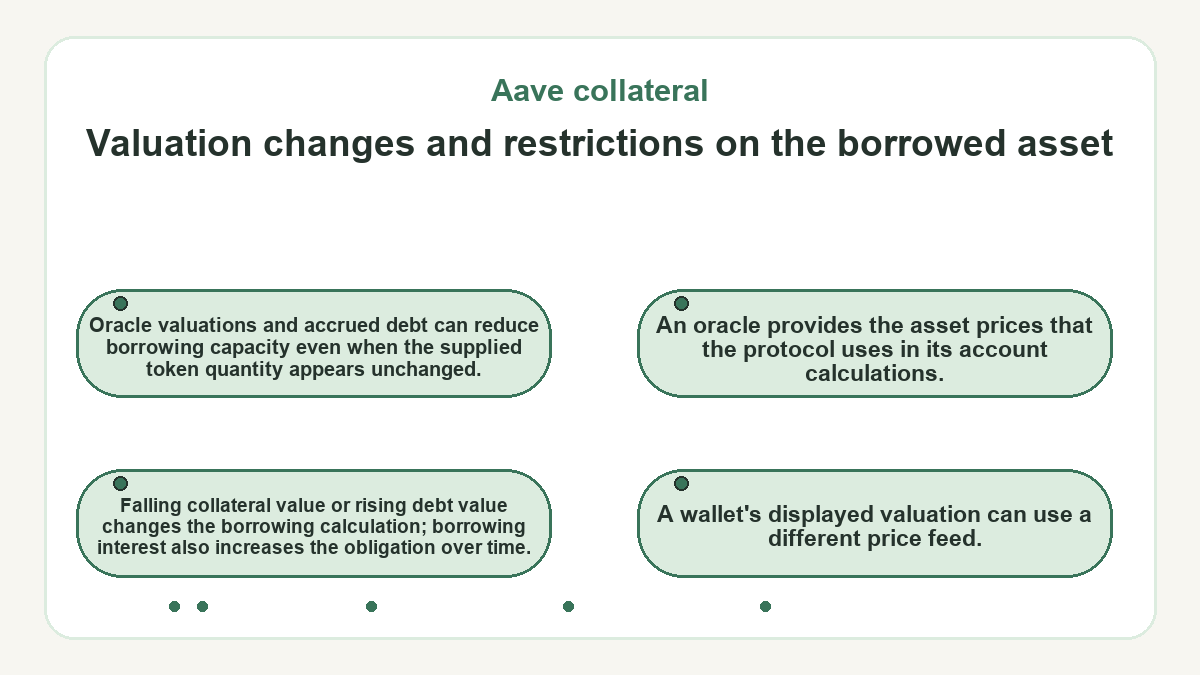
The requested asset has separate availability conditions. Its reserve, the asset's pool within a market, must permit borrowing and have enough available liquidity. A borrow cap limits aggregate borrowing of that asset. An inactive, frozen or paused reserve can block a new loan even when the account has sufficient collateral. Adding collateral doesn't remove those restrictions.
Enabling collateral for the requested loan
Consider a hypothetical account that shows a supplied balance but no borrowing capacity. All changing inputs in this example are hypothetical: the sole supplied asset has a value of 7 842 valuation units, its effective LTV is 63% and the account has no debt. The intended loan has a value of 3 426 units in the same valuation currency. The asset qualifies as collateral, but its collateral setting is off.
Before changing anything, the reader checks the account and market, confirms the supply transaction and reads the collateral setting. Those checks isolate the disabled setting without adding more funds. Enabling the eligible asset would produce LTV-based capacity of 7 842 × 0.63 = 4 940.46 units. The requested loan fits that boundary, leaving 1 514.46 units of LTV headroom at the assumed valuations.
The reader confirms the collateral change, then checks the resulting setting and recalculated capacity. A borrow attempt follows only if the requested asset passes its availability checks and the resulting position passes the health requirements. A successful borrow transaction should leave the borrowed tokens in the wallet and a corresponding debt balance in the account. Later debt includes accrued interest; the initial headroom calculation doesn't promise a fixed borrowing cost.
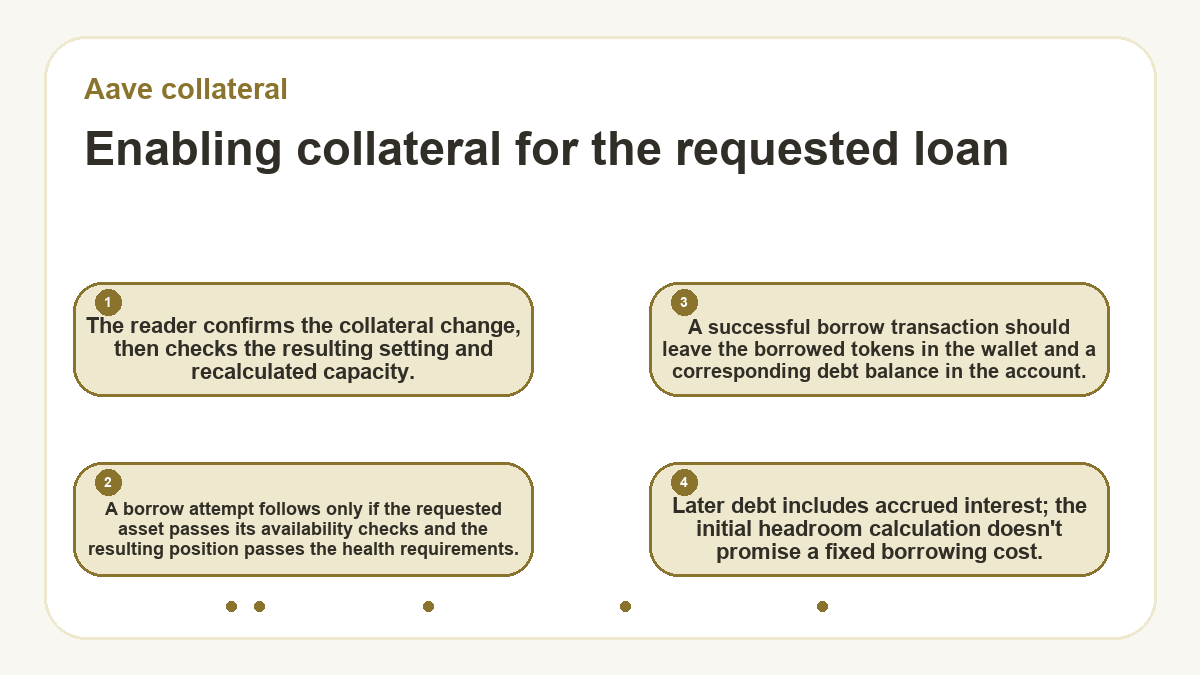
A changed valuation or different effective LTV requires recalculating capacity. A newly binding reserve restriction can block the loan even if that calculation is unchanged. A pending transaction calls for checking its status before another submission. If collateral becomes enabled but the loan remains unavailable, the reader stops repeating the toggle and examines the reported borrowing restriction. The setting change has completed even though the separate loan hasn't.
Zero-LTV restrictions during an adjustment
Zero-LTV collateral can restrict adjustments to other collateral in a V3 position that still has outstanding debt. Applicable validation rules require the zero-LTV collateral to be addressed before withdrawing or transferring other collateral. This can explain a rejected adjustment even when the displayed health factor appears sufficient.
Disabling collateral removes its contribution to account health, so the remaining position must still satisfy the protocol's requirements. Repayment or additional eligible backing may be necessary before that change becomes possible. Withdrawal also requires available liquidity. Switching eMode isn't an unconditional escape: the destination mode must accept the existing debt and collateral, and the resulting position must pass health checks.
Legacy isolation and deployment-specific borrowing stops
Older V3 implementations that retain legacy Isolation Mode restrict which supplied assets can participate together as collateral. An isolated asset cannot combine with other enabled collateral. Loans must use assets approved for isolation borrowing and fit within the isolated collateral's aggregate debt ceiling. Supplying another asset therefore needn't increase usable backing. Legacy Isolation Mode and V3.7 isolated eMode are different mechanisms; the deployment's version determines which rules apply.
Some deployments also use a price-oracle sentinel, a safeguard that can suspend borrowing around sequencer downtime and recovery conditions. A sequencer orders transactions on certain scaling networks. Where the sentinel applies, additional collateral won't clear its restriction. Borrowing must wait until the configured recovery conditions permit it.
Account evidence before another attempt
Match the wallet and market first. Confirm the supplied balance, enabled collateral and selected mode, then subtract existing debt from the effective LTV-based borrowing limit and compare the remainder with the proposed loan. Check the requested reserve's liquidity and restrictions separately.
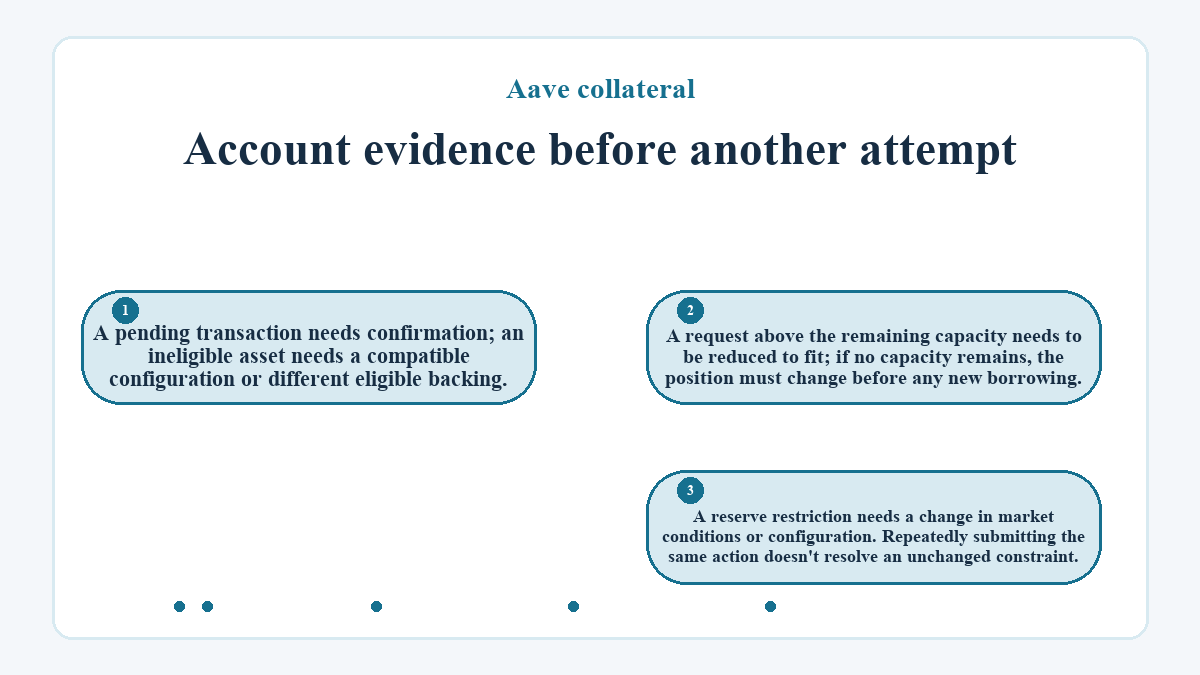
A pending transaction needs confirmation; an ineligible asset needs a compatible configuration or different eligible backing. A request above the remaining capacity needs to be reduced to fit; if no capacity remains, the position must change before any new borrowing. A reserve restriction needs a change in market conditions or configuration. Repeatedly submitting the same action doesn't resolve an unchanged constraint.
Aave collateral - common questions
Why didn't received aTokens become usable collateral?
In V3.6, receiving aTokens through a transfer no longer automatically enables the corresponding asset as collateral. The balance and collateral flag can therefore disagree with an expectation based on older behavior. Manual enablement remains subject to the asset's effective LTV and the account's configuration. A direct supply follows different automatic-enablement rules.
Does approving a token establish an Aave collateral position?
A token approval authorizes spending but doesn't itself supply the tokens or establish collateral. The supply transaction must execute and credit the intended beneficiary. Collateral eligibility and the account's collateral setting then determine whether that supply contributes borrowing power. An approval confirmation alone doesn't establish any of those later states.
Is a missing health factor evidence that my collateral failed?
A missing health factor doesn't establish a collateral failure when the account has no outstanding borrow position. The V3 API's account-health data reports a null health factor for supply-only accounts. Borrowing eligibility instead depends on the supplied assets, their enabled status and their effective borrowing parameters in the selected market.
Can supplied assets earn interest while their collateral setting is off?
Disabling collateral doesn't by itself stop supply interest. The supplied balance remains in the reserve and follows its supply-rate mechanics. Collateral status controls whether the asset backs borrowing, while the supply rate follows the reserve's conditions. Earning interest therefore doesn't establish that the same balance qualifies to support a loan.
Which part of my supplied balance does the V3 collateral toggle affect?
The V3 collateral toggle applies to the account's supplied balance of that reserve, rather than a separately chosen portion. It doesn't allocate a specified token amount to collateral. Disabling it removes that reserve's contribution to the account's collateral calculation, subject to the checks that protect any outstanding debt.
Will a full supply cap remove the borrowing power of an existing deposit?
Reaching a supply cap doesn't by itself disable an existing deposit's collateral contribution. The cap limits additional supply to the reserve. Existing borrowing power still depends on the collateral setting, effective LTV and account state. A separate parameter change can affect eligibility, so a supply-cap warning and a collateral restriction describe different conditions.